The perfect 4DGS
volumetric capture studio
for your XR applications

4DGS is Gaussian Splatting ... for video !

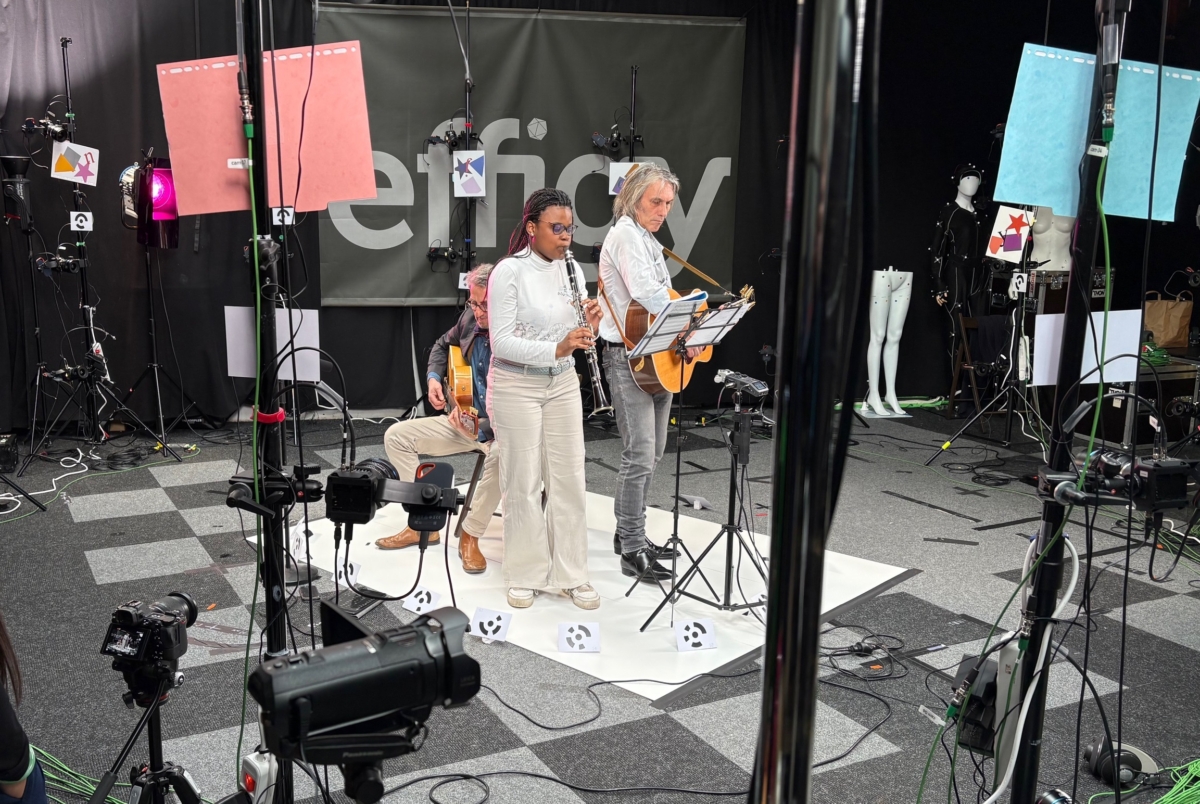
Early 2026, Effigy has opened a filming studio optimized for 4DGS volumetric video shooting…

  • located in downtown Paris 15, 
  • fifty genlocked 4K cameras,
  • of adjustable size and layout, 
  • No green screen, free lighting
  • and transportable throughout Europe

The studio combines the image quality of a traditional video production with the full potential of virtual production to create hyper-realistic, immersive 3D content.

The 3D videos thus generated are compatible with the most popular virtual production softwares: Unreal, Unity, Blender, C4D, Houdini, After Effects…

Three options for integration into your applications:

– in «flipbook» format = a series of uncompressed Gaussian Splatting PLY images, it’s the perfect workflow for video post-production

– encoded in MINT, Gracia's great file format, the format of Gracia Lighter and with an intermediate bitrate, it's the ideal compromise for XR productions and other interactive applications.

– in .Mint format, at low bitrate (70 Mb/sec) for Mixed Reality streaming for example, a bitrate largely compatible with 5G

What is 4DGS?

Volumetric Capture, a tech that merges Video and 3D
Volumetric capture transforms the way we film reality; unlike traditional video which captures flat images = in 2D, it captures the full volume of a scene — depth, movement, texture — and creates true 3D videos = spatialized video scenes, with photorealistic quality.

4DGS is where Gaussian Splatting boosts Volumetric Capture
4DGS (4D Gaussian Splatting) reconstructs each frame of a scene with millions of Gaussian "splats"—3D primitives, each possessing its own position, orientation, color, and opacity. The "4D" prefix adds a temporal dimension to the spatial dimension of Gaussian Splatting; movement is captured and rendered with its natural fluidity.

Decisive features for post-production and XR!
– Photorealistic quality: Exceptional reproduction of micro-expressions, skin translucency, light interactions — it surpasses all other 3D animation techniques, and is much easier to produce
– A revolution for video production: Once captured, the performance can be edited from any angle, a virtual camera can be freely moved around the scene in post-production, the lighting can be adjusted, and even special effects can be applied.
– Total creative freedom for the XR: with 4DGS, it is now possible to integrate the actions of filmed characters into full 3D scenes

Training, culture, sport, from XR to Post-Production: very concrete applications

– In movie production, 4DGS allows for ultra-realistic digital doubles and a virtual production that is much simpler and more natural than Motion Capture animation work on Avatars.
– In video games, it offers characters of unprecedented realism, way beyond AAA!
– In VR/AR, it establishes a disturbing human presence in increasingly realistic virtual scenes!
– Less public, but 4DGS is also used for training AI models on human movements

And beyond the entertainment sector, 4DGS technology will transform professional training (interactive consultation of gestures from all angles), education (virtual lecturers) and cultural heritage (preservation of artistic performances).

Thus, 4D Gaussian Splatting is not simply an improvement on 3D animation techniques: it is a revolution in the world of 3D, the boundary between real and virtual is blurring, and this will profoundly enrich visual creation and future virtual worlds.

A modular 100% film studio

Effigy has designed this studio as specificaly modular, which means that…
– the size is variable, for filming in close-up, portrait, full-length, or with several people on screen
– The camera layout is fully customizable, to make the most of Gaussian Splatting depending on the 3D navigation scenario
– the lighting is also completely customized (unlike traditional photogrammetry which requires flat lighting). And no green screen needed.
– the equipment is transportable to another filming location; we have already carried out several shoots in Italy and Germany.

Test out some 4DGS models
from the application below

Launch the Unreal application below (PixelStreaming technology), and freely manipulate several example 4DGS files (intermediate quality).
The "TAB" key displays the main controls. To turn on the sound, activate the speaker (button at the bottom right).
At the end of the session, please exit the program by pressing "ESC" (escap) for 3 seconds.

Arcware Pixel Streaming WebSDK
Loading Pixel Stream...

FAQ

These technologies often start with images or videos, but they do not produce the same type of result.

Photogrammetry transforms 2D images into static 3D objects. It is very useful for reconstructing a subject or setting, but often requires retouching to obtain a clean result.
3D Gaussian Splatting transforms 2D images into an enriched point cloud, capable of reproducing light, matter and visual details with a rendering very close to reality.
Motion capture analyzes video or sensors to generate an animated skeleton. This movement must then be transposed onto a 3D character.
Volumetric video transforms a 2D video into an animated 3D object, visible from multiple angles.
The 4DGS goes further: it transforms video into an animated point cloud. It allows for the capture of human performance with a photorealistic rendering, very close to reality, while preserving the subject's movement, volume, lighting, and details.

4DGS allows for a very realistic rendering of a person or scene in motion. It is particularly useful when the goal is to preserve the subject's true appearance: face, clothing, textures, lighting, micro-movements, and human presence.

It offers a more natural rendering than a manually animated 3D character or a simple video capture, because the scene can be observed from multiple angles.

Its limits depend on the project: duration of the sequence, complexity of the movements, number of people, file size, end use and constraints of integration into a real-time engine.

Yes. 4DGS files can be integrated into 3D environments and real-time engines such as Unity Or Unreal Engine, in particular with the plugin Gracia. It is used via drag and drop, and the model integrates with all other assets in the scene.

The integration allows for the insertion of a photorealistic human performance directly into a 3D scene, an XR experience, an interactive installation, or a real-time prototype. The result is particularly stunning when used in an immersive environment.

No, no green screen is needed. The technology of Gaussian Splatting allows you to do away with the green screen.

This offers greater freedom during filming: more natural lighting, more varied sets, less restrictive costumes, and a result closer to a real-life recording. This is a significant advantage compared to some traditional video, VFX, or volumetric capture workflows.

Effigy can capture different types of scenes depending on the project's needs:

  • portrait or close-up; ;
  • full-length character; ;
  • human performance; ;
  • several people; ;
  • professional skill or demonstration; ;
  • artistic, cultural or educational intervention; ;
  • Recording in a studio or with a portable setup…

The timeframe depends on the complexity of the project, the number of people to be captured, the length of the sequences, and the type of deliverable expected.

A project generally unfolds in several stages: defining the need, preparing for filming, possible tests, capture, data processing, quality control, and then delivery of the files.

One of the advantages of 4DGS is that it greatly reduces the need for retouching manual compared to some traditional 3D workflows. In short, after filming, it only takes a few days to render/filter several minutes of 4DGS.

Yes, no problem.
Our setup is designed to be transported outside the studio, in France or Europe, depending on the project constraints. This allows for recording to be organized at a specific location: event, museum, production set, brand space, training center or industrial site.
In just a few months of operation, Effigy has already gone abroad to shoot 4DGS productions.

The cost of a 4DGS shoot, like any shoot, depends on several factors: shooting duration, number of people, complexity of the scene, shooting location, volume of data, delivery format, level of technical support….

Rather than a single price, we recommend evaluating each project according to its end use: video, XR, Unity, Unreal, prototype, interactive installation or complete production.

The cost of filming must be taken into account (around €6,000 per day at the Effigy studio in Paris 15, or from €10,000 on an external location or set).

To get an accurate estimate, the easiest way is to send us a brief with the type of scene to be captured, the desired duration, the number of people and the expected format.

.

Yes, 4DGS can be streamed, and with an excellent quality-compression ratio, and a bitrate of around 70 Mbs.
Our 4DGS processing partner Gracia offers three types of 4DGS processing
– in «flipbook» quality, i.e., with very little compression, i.e., maximum quality
– in an intermediate version, the right mix for applications where data can be downloaded, for example with a Virtual Reality headset
– in a streamable version, for photorealistic animated 3D with unprecedented quality!

The 4DGS allows for a quality photorealistic, with a rendering very close to reality. Depending on the pipeline chosen, the deliverables can even aim for broadcast quality in "uncompressed" form.

This technology is particularly suited to projects where human presence, facial details, clothing, lighting, and a sense of realism are essential.

Effigy has been developing expertise in 3D scanning, motion capture, bullet time, virtual production, Gaussian for over 10 years and has produced images for numerous projects, including the most demanding 4DGS.
Thanks to our modular setup, available in studio or transportable, and state-of-the-art equipment, our team combines expertise in production, 3D, XR and technical integration to deliver formats suitable for both post-production and interactive experiences.